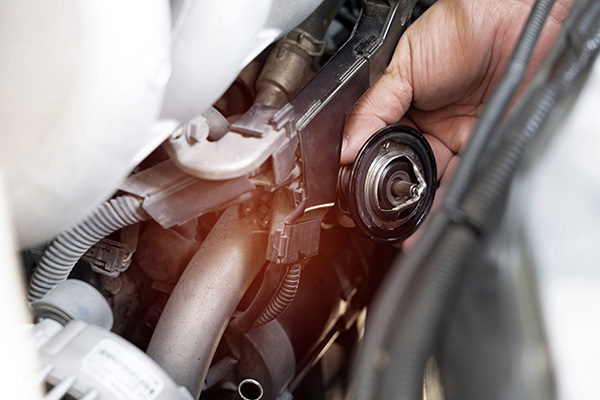
When the heater starts blowing lukewarm air on a cold morning, it is easy to assume the problem is somewhere inside the dashboard. Sometimes it is, but a thermostat stuck open can create the same complaint because the engine itself never gets hot enough to supply strong cabin heat.
The clue is usually in what the temperature gauge does while you drive. If the engine warms very slowly, the gauge stays below its normal position, and the heater gets weaker at highway speed, the thermostat deserves close attention.
A Stuck-Open Thermostat Lets Coolant Circulate Too Early
The thermostat controls when coolant begins flowing through the radiator. When the engine is cold, it should stay closed so it can reach operating temperature quickly.
If the thermostat sticks open, coolant circulates through the radiator as soon as the engine starts. The radiator keeps removing heat even while the engine is still warming up. You can drive for quite a while and still see the temperature gauge sitting lower than normal.
The Heater Depends on Hot Engine Coolant
Your cabin heater uses heat that already exists in the cooling system. Hot coolant flows through a small radiator called the heater core, and the blower pushes air across it before sending that air through the vents.
When engine coolant never gets hot enough, the heater core cannot provide much warmth. You may get air that feels slightly warm but never becomes properly hot. In colder weather, the difference becomes more noticeable because outside air removes heat from both the radiator and the cabin.
Highway Driving Can Make the Heat Get Colder
One of the strongest clues of a stuck-open thermostat is heater performance that gets worse once you reach highway speed. Faster driving pushes much more outside air through the radiator.
If coolant is already circulating through the radiator too soon, that airflow pulls even more heat away from the engine. The temperature gauge can drop, and the vents may begin blowing cooler air even though you have been driving for twenty or thirty minutes. At our shop, that city-versus-highway change is useful information when we are checking thermostat operation.
The Temperature Gauge Should Reach Its Normal Range
Most vehicles reach a fairly consistent operating temperature once they are warmed up. The gauge should rise from cold and settle near its normal position rather than staying near the bottom throughout the trip.
A gauge that barely moves doesn't automatically mean the thermostat is bad. A coolant temperature sensor, wiring problem, or instrument cluster issue can report the wrong temperature. During an inspection, we compare what the vehicle reports with the actual coolant temperature before recommending a thermostat replacement.
Low Coolant Can Also Make the Heater Stop Working
A low coolant level can produce weak or inconsistent heat because the heater core may not stay full of hot coolant. Air trapped in the system can do the same thing.
You might notice the heater changing from warm to cold during turns or acceleration, or hear gurgling behind the dashboard. Low coolant needs a different repair than a stuck thermostat, so we check for leaks around hoses, the radiator, water pump, thermostat housing, expansion tank, and other cooling-system connections before assuming the thermostat is responsible.
A Restricted Heater Core Feels Similar but Behaves Differently
A partially clogged heater core can leave you with weak cabin heat even when the engine reaches normal temperature. That difference is important.
If the temperature gauge sits where it always has but the vents stay cool, we start looking more closely at coolant flow through the heater core and climate-control operation. Comparing the heater hose temperatures can help. If one hose is hot and the other is much cooler, coolant may not be circulating through the core properly. With a stuck-open thermostat, the entire engine tends to run colder than it should.
Running Too Cool Affects More Than Comfort
Driving with a stuck-open thermostat is not as immediately dangerous as driving with an overheating engine, but it should still be repaired. Modern engines are designed to operate within a specific temperature range.
When the engine stays too cool, the computer can keep the fuel mixture richer for longer. Fuel economy can drop, deposits can increase, and engine oil takes longer to reach the temperature needed to evaporate moisture from short trips. Regular maintenance also becomes harder to judge when the engine spends most of its time below its intended operating temperature.
Confirm the Thermostat Before Replacing It
A thermostat is a common cause of slow warm-up and poor cabin heat, but several other problems can imitate it. Coolant level, sensor readings, heater core flow, cooling fan operation, and actual engine temperature all help tell the story.
We watch how the coolant temperature rises from a cold start and what happens once the vehicle is driven. A thermostat stuck open often causes a slow warm-up followed by temperature loss during steady cruising. Once you confirm that pattern, the repair becomes much more straightforward.
Get Thermostat and Heater Service In Bear, DE, With Fox Run Auto
If your engine takes too long to warm up, the temperature gauge stays low, or the heater gets colder on the highway, Fox Run Auto in Bear, DE, can check thermostat operation, coolant level, heater core flow, and actual engine temperature.
Schedule a cooling-system check before a stuck-open thermostat leaves you with poor heat and an engine that never reaches its designed operating temperature.